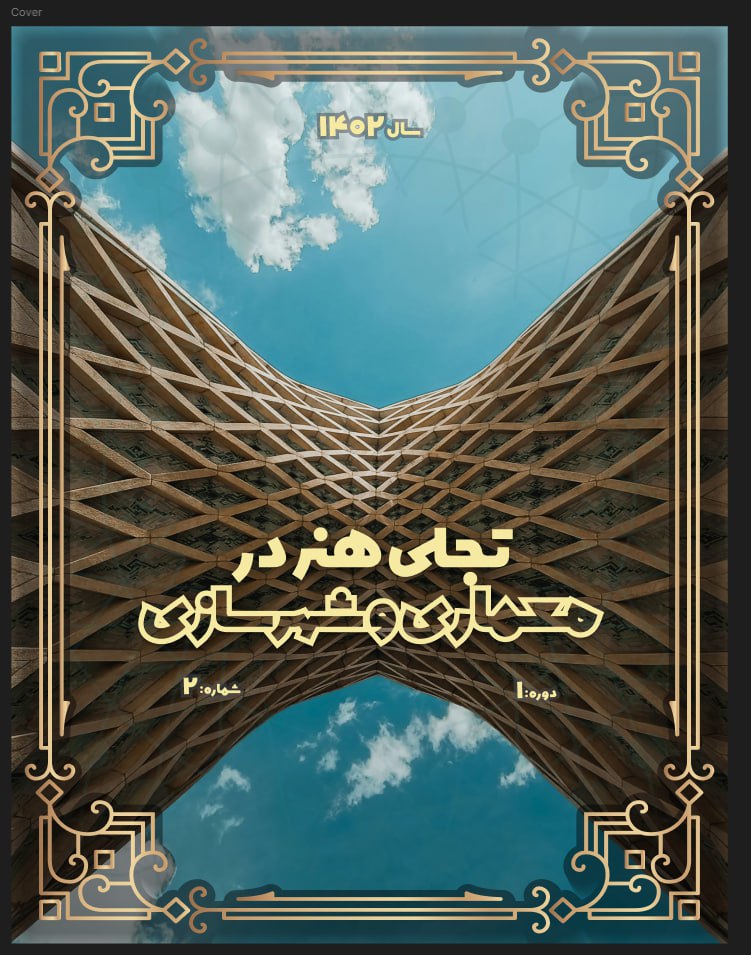
A Semiotic Reading of the Architecture of the Jameh Mosque of Yazd from the Ilkhanid to the Timurid Period, with Emphasis on Muzaffarid Transformations
Keywords:
Phenomenology of place, physicalism, crisis of meaning, lifeworld, philosophical rethinkingAbstract
Religious architecture is not merely a container for the performance of rituals; rather, it participates in the production of meaning through spatial organization, orientation, scale, movement sequences, inscriptions, and ornamentation. The central problem of this study is how the architecture of the Jameh Mosque of Yazd can be analyzed in relation to its spatial structure and historical layers without reducing its constituent elements to a set of fixed and transhistorical symbols. The study employs a qualitative, historical–interpretive, case-study approach. Its theoretical framework is based on Charles Sanders Peirce’s triadic relationship among the representamen, object, and interpretant, as well as his distinction among icon, index, and symbol. The data corpus consists of authoritative sources on architectural history, studies specifically addressing the Jameh Mosque of Yazd, research on inscriptions and ornamentation, architectural plans, and published visual documentation. The analysis was conducted at three levels: chronology, the sign relations of architectural elements, and the spatial network. Operational criteria were employed to identify iconic, indexical, and symbolic relations. The findings indicate that, within the principal sequence of spatial experience in the mosque, indexical relations play a more fundamental role than isolated symbols in terms of their functional priority and recurrence in orientation, connection, adjacency, and focalization. The entrance portal, threshold, pathway, courtyard, qibla iwan, domed chamber, and mihrab, through their actual positions and spatial connections, organize ritual movement and concentration, whereas inscriptions and the culturally informed recognition of certain elements reinforce symbolic layers of meaning. The historical analysis further demonstrates that the existing network of signification was not formed in a single phase. Muzaffarid interventions, particularly those undertaken in 1375–1376, in the entrance, inscriptions, mihrab, and ornamentation of the principal space are crucial to interpreting the building in its present form. The study’s contribution lies in shifting the unit of analysis from the “element as symbol” to the “relation as sign” and in simultaneously integrating architectural form, the object of signification, interpretive effect, type of sign relation, and historical context.
Downloads
References
1. Seamon D. A Geography of the Lifeworld (Routledge Revivals): Movement, Rest and Encounter: Routledge; 2015.
2. Dovey K. Place as Multiplicity. Routledge; 2016. p. 257-68.
3. Palermo PC, Ponzini D. Place-Making and Urban Development: New Challenges for Contemporary Planning and Design: Routledge; 2015.
4. Knox PL. Creating Ordinary Places: Slow Cities in a Fast World. Journal of Urban Design. 2005;10(1):1-11.
5. Kovács Z, Musterd S. The Importance of Places and Place Branding. Wiley-Blackwell; 2013. p. 97-104.
6. Relph E. Place and Placelessness. 4th ed: SAGE; 2016.
7. Bricocoli M, Savoldi P. Milano Downtown: Azione Pubblica e Luoghi dell’Abitare: et al./EDIZIONI; 2010.
8. Loghaei H, Hasibi A, Fallah Farbod SS. Strategies for Revitalizing and Organizing Urban Parks to Improve Ecological and Social Quality: A Case Study of City Park in the Sanglaj Neighborhood. Journal of Natural Resources Science and Technology. 2011;3(6):99-114.
9. Dadbeh A. Schools of Garden Design. Museums Journal. 2004(41):32.
10. Abolghasemi L, editor The Norm of the Persian Garden through History1995; Bam Citadel, Kerman, Iran.
11. Ardalan N, Bakhtiar L. The Sense of Unity: The Sufi Tradition in Persian Architecture: Khak Publishing; 2000.
12. Bemanian M, Taghvaei AA, Shahidi MS. An Examination of Cultural-Environmental Foundations in the Physical Elements of Persian Gardens before and after Islam. Environmental Science and Technology Quarterly. 2008;10(1):103-12.
13. Pourmand H, Keshtkar Ghalati A. An Analysis of the Existential Causes of the Formation of the Persian Garden. Honar-Ha-Ye-Ziba: Architecture and Urban Planning. 2011;3(47):51-62.
14. Mirfendereski MA, editor The Garden as an Antecedent of the City1995; Bam Citadel, Kerman, Iran.
15. Daneshdoost Y. Tabas, the City That Was: The Gardens of Tabas: Cultural Heritage Organization of Iran and Soroush Publications; 1990.
16. Rabbani R, Nazari J, Mokhtari M. A Sociological Explanation of the Functions of Urban Parks: A Case Study of Parks in Isfahan. Urban and Regional Studies and Research. 2011;3(10):111-34.
17. Shahcheraghi A. Paradigms of Paradise: An Introduction to the Recognition and Re-Creation of the Persian Garden: University Jihad Organization of Tehran; 2010.
18. Seamon D. A Geography of the Lifeworld: Movement, Rest, and Encounter: St. Martin’s Press; 1979.
19. Buttimer A. Home, Reach, and the Sense of Place. Croom Helm; 1980. p. 166-87.
20. Cresswell T. Geographic Thought: A Critical Introduction: Wiley-Blackwell; 2013.
21. Seamon D. Movement, Rest, and Encounter: A Phenomenology of Everyday Environmental Experience. Worcester, MA: Clark University; 1977.
22. Cerbone DR. Understanding Phenomenology: Acumen; 2006.
23. Seamon D, Gill HK. Qualitative Approaches to Environment–Behavior Research: Understanding Environmental and Place Experiences, Meanings, and Actions. Wiley; 2016. p. 115-35.
24. Compton JJ. Existential Phenomenology. Kluwer Academic Publishers; 1997. p. 205-9.
25. Seamon D. Phenomenological Perspectives on Place, Lifeworlds, and Lived Emplacement: The Selected Writings of David Seamon: Routledge; 2023.
26. Malpas J. Place and Experience: A Philosophical Topography: Cambridge University Press; 1999.
27. Cloke P, Philo C, Sadler D. Approaching Human Geography: An Introduction to Contemporary Theoretical Debates: Paul Chapman; 1991.
28. Haapala A. The Everyday, Building, and Architecture: Reflections on the Ethos and Beauty of Our Built Surroundings. Cloud-Cuckoo-Land: International Journal of Architectural Theory. 2017;22(36):171-82.
29. Heidegger M. Being and Time. 4th ed: Basil Blackwell; 1978.
30. Olivier A. Understanding Place. Springer; 2017. p. 9-22.
31. Lehtinen S, Vihanninjoki V. Aesthetic Perspectives on Urban Technologies: Conceptualizing and Evaluating the Technology-Driven Changes in the Urban Everyday Experience. Springer; 2021. p. 13-35.
32. Van Manen M. Phenomenology of Practice: Meaning-Giving Methods in Phenomenological Research and Writing: Left Coast Press; 2014.
33. Merleau-Ponty M. Phenomenology of Perception: Routledge & Kegan Paul; 1962.
Downloads
Publication Timeline
- Submitted
- Revised
- Accepted
Issue
Section
License
Copyright (c) 2025 Rasouli Rasouli; Nasser Barati (Author)

This work is licensed under a Creative Commons Attribution-NonCommercial 4.0 International License.