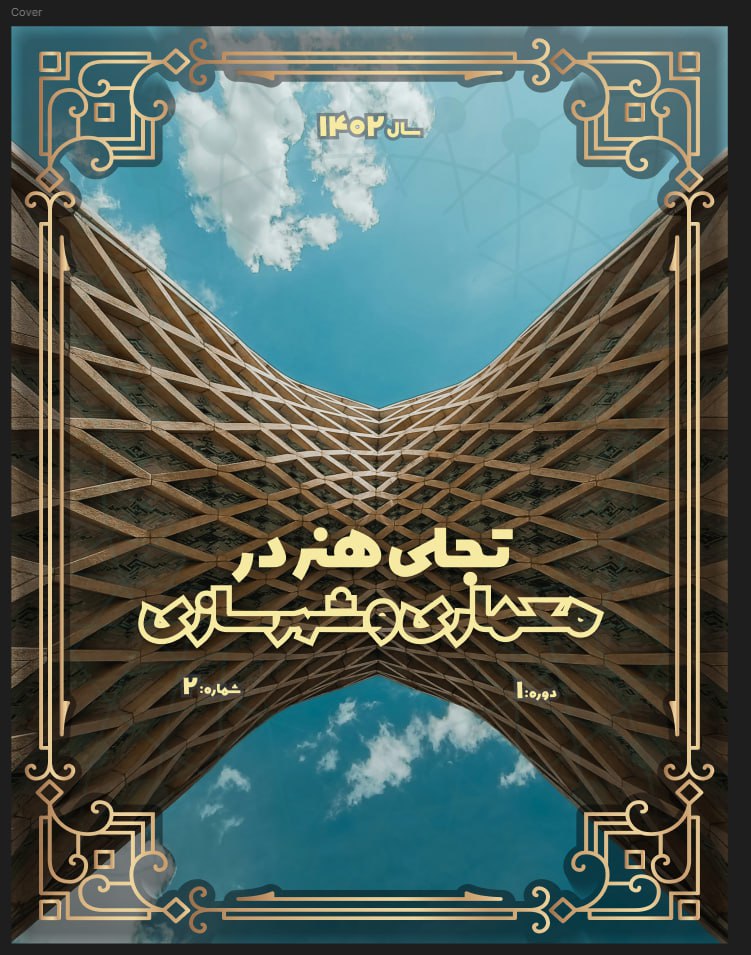
Reimagining the Visual Components of Iranian Art in Contemporary Architecture Using Generative Artificial Intelligence: Investigating Its Effects on the Perception of Spatial Identity and Aesthetics
Keywords:
Generative artificial intelligence, Iranian art, Contemporary architecture, Spatial identity, Aesthetics, Architectural designAbstract
This study aimed to investigate the effect of reimagining the visual components of Iranian art in contemporary architecture using generative artificial intelligence on users’ perceptions of spatial identity and architectural aesthetics. This applied quantitative study employed a quasi-experimental comparative design with 240 adult residents of Tehran, who were randomly assigned to an experimental group and a comparison group, with 120 participants in each. The experimental group viewed contemporary architectural images in which Iranian visual components, including geometric patterns, arabesque and floral motifs, symmetry, rhythm, lattice structures, and color organization, had been reinterpreted and integrated through generative AI. The comparison group viewed corresponding versions of the same architectural spaces without these interventions. Data were collected using a questionnaire assessing spatial identity and aesthetic perception and were analyzed in SPSS version 27 using Pearson correlation, multivariate analysis of variance, univariate analysis of variance, multivariate analysis of covariance, and multiple linear regression. The overall multivariate effect of group on the combined measures of spatial identity and aesthetic perception was statistically significant (Wilks’ Lambda=0.508, F=114.77, p<0.001, η²p=0.492). Significant group effects were also found for spatial identity (F=164.86, p<0.001, η²p=0.409) and aesthetic perception (F=151.72, p<0.001, η²p=0.389). These effects remained significant after controlling for background variables. Spatial identity was positively correlated with aesthetic perception (r=0.684, p<0.001). The regression model explained 62.90% of the variance in aesthetic perception, with visual harmony emerging as the strongest predictor (β=0.337, p<0.001). The integrated reinterpretation of Iranian visual components through generative AI can significantly strengthen perceptions of identity, aesthetic quality, authenticity, visual harmony, and innovation in contemporary architecture, providing an effective framework for connecting cultural heritage with contemporary design language.
Downloads
References
1. Jahanbakhsh H, Daneshjoo F, Sheibani N, Sheibani H. Analyzing the Characteristics of Architecture and the Structure of 'Urban'Design in 'Arsen-e Zandieh', Shiraz. Iranian Urban Design Studies. 2025;1(2):321-44.
2. Veisi B, Alaei A. The Impact of Islamic Pillars and Elements on the Formation of Iranian Cities. International Conference on Architecture, Urbanism, Art, Industrial Design, Construction and Governance Technology2024.
3. Baniasadi M. Aesthetic transitions in Iranian architecture during the modernization era. Journal of Iranian Architecture. 2019;12(3):45-62.
4. Akhgar P, Moulis A. The Beaux-Arts System and the Construction of Iranian Architectural Modernism in the Twentieth Century. Journal of the Society of Architectural Historians. 2025;84(1):39-63.
5. Abbasi Z. Analysis of urban facade bylaws and regulations based on Iranian and Islamic architecture criteria in Qom. Qom Municipality; 2025.
6. Li Y, Chen H, Yu P, Yang L. A review of artificial intelligence in enhancing architectural design efficiency. Applied Sciences. 2025;15(3):1476.
7. Almaz AF, El-Agouz, Elsayed Abd El-azim, Abdelfatah, Mohab Taher, Mohamed, Islam Rafaat. The Future Role of Artificial Intelligence (AI) Design's Integration into Architectural and Interior Design Education is to Improve Efficiency, Sustainability, and Creativity. Sustainability, and Creativity. 2024;3(12):1749-72.
8. AlShkipi A, Zahran O. Implementation of artificial intelligence in interior design: Systematic literature review. Civil Engineering and Architecture. 2024;12(4):2889-906.
9. Chandrasekera T, Hosseini Z, Perera U. Can Artificial Intelligence Support Creativity in Early Design Processes? International Journal of Architectural Computing. 2024;23(1):122-36.
10. Meng Q, Ge M, Zhang F. The Integration of Artificial Intelligence in Architectural Visualization Enhances Augmented Realism and Interactivity. 2024.
11. Botros C, Mansour Y, Eleraky A. Architecture Aesthetics Evaluation Methodologies of Humans and Artificial Intelligence. Msa Engineering Journal. 2023;2(2):450-62.
12. Palmini O, Cugurullo F. Charting AI urbanism: conceptual sources and spatial implications of urban artificial intelligence. Discover Artificial Intelligence. 2023;3(1):15.
13. Hazarkhani M. Sustainable Architectural Design Using Artificial Intelligence Models: Revisiting Energy Consumption Patterns in Buildings. 2025.
14. Beyari H. Artificial intelligence's effect on customer loyalty in the context of electronic commerce. Journal of Umm Al-Qura University for Engineering and Architecture. 2025;16:617-26.
15. Rostami M, Shirazi S. The Role of Artificial-Intelligence-Based Customer Relationship Management in Relationship Marketing. Fourth International Conference on Architecture, Civil Engineering, Urban Planning, Environment, and Prospects of Islamic Art in the Statement of the Second Step of the Revolution2025.
Downloads
Publication Timeline
- Submitted
- Revised
- Accepted
Issue
Section
License
Copyright (c) 2026 Seyyed Mohsen Haji Seyyed Javadi

This work is licensed under a Creative Commons Attribution-NonCommercial 4.0 International License.