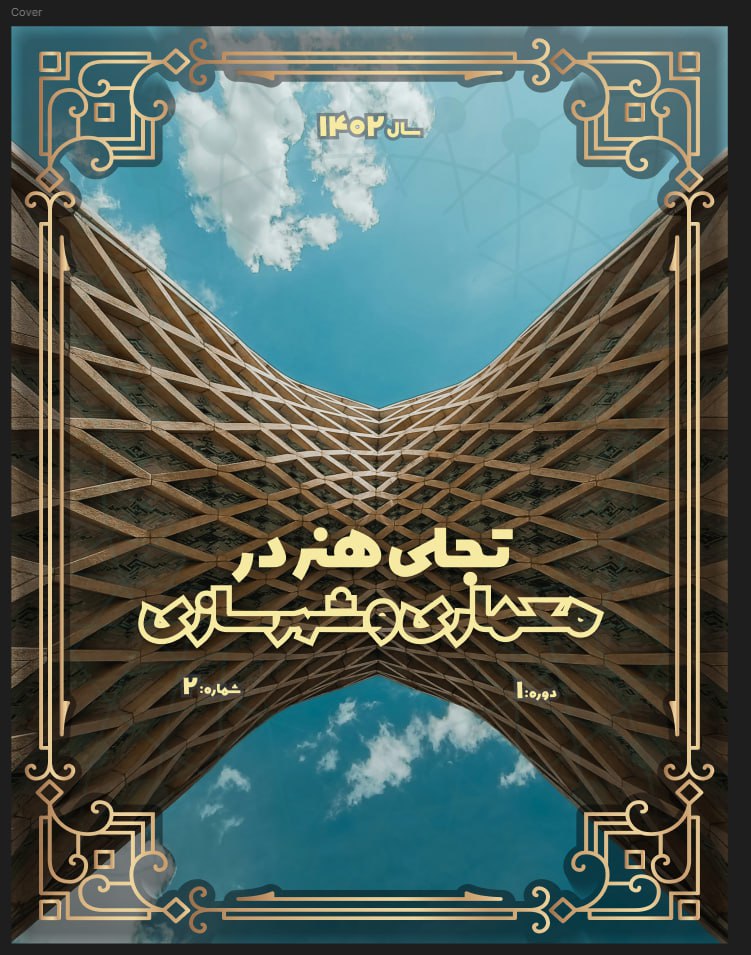
Explaining the Environmental Components of Architecture Vocational Schools in Enhancing Problem-Solving Skills, Design Thinking, and Ideation Ability (Students’ Cognitive Skills)
Keywords:
Sari City, Structural Equation Modeling (SEM), Analytic Network Process (ANP), Urban Governance, Participatory Practices, Tactical UrbanismAbstract
The educational environment is one of the fundamental contexts shaping the quality of education and the development of professional competencies among students in architecture vocational schools. This study aimed to explain the role of environmental factors in architecture vocational schools in enhancing students’ problem-solving skills, design thinking, and ideation abilities. The study adopted an analytical qualitative approach based on library research. The required data were collected and analyzed through a review of books, domestic and international scholarly articles, and relevant sources in the fields of architectural education and learning-space design. The findings indicate that the quality of educational spaces, specialized design workshops and studios, facilities and equipment, up-to-date technologies, lighting, ventilation, spatial organization, and educational interactions are among the most important environmental components affecting the development of students’ professional competencies. Dynamic, flexible, and well-equipped educational environments provide a supportive context for fostering creativity, strengthening design thinking, enhancing problem-solving skills, and expanding ideation capabilities. Overall, improving the environmental components of architecture vocational schools can facilitate the enhancement of the teaching–learning process and contribute to the development of creative, competent, and problem-oriented students.
Downloads
References
1. Speck J. Urban planning in the era of rapid urbanization: Rethinking traditional city management models. Cities. 2021;115:103256.
2. Habitat UN. World Cities Report 2020: The value of sustainable urbanization. United Nations Human Settlements Programme; 2020.
3. Agharian E, Nabati Nejad M, Zakeri A. A model of urban governance based on citizen participation. Strategic Research on Social Problems. 2024;13(2):47-68.
4. Rousta M, Ebadi M, Soltani A. Tactical urbanism: What, why and how: Developing a theoretical framework through a review study and content analysis. Urban Economics and Planning. 2022;3(2):106-21.
5. Lydon M, Garcia A. Tactical urbanism: Short-term action for long-term change: Island Press; 2015.
6. Aghajanzadeh H. Michel de Certeau and the historiography of everyday life: A self-reflexive encounter through the experience of cultural studies in Iran. Iranian Journal of Cultural Research. 2024;17(3):143-71.
7. Askari H, Daniali T, Hemmati M. The effects of tactical urbanism on enhancing urban resilience: A case study of Tehran Municipality District 14. Urban Economics and Planning. 2024;5(4):82-97.
8. Felizardo ACMD. Tactical urbanism: Description and analysis of its associated lexicons. Contemporary Heritage Lexicon2024. p. 67-81.
9. Seghetto I. Virtual reality as a tool for enhancing understanding of tactical urbanism. Architecture. 2025;5(2):26.
10. Westin S. The framing of power in communicative planning theory: Analysing the work of John Forester, Patsy Healey and Judith Innes. Planning Theory. 2022;21(2):132-54.
11. Doğu A, Mengi O, Köse E. Where do temporary urban design interventions fall on the spectrum of public participation? An analysis of global trends. Cities. 2024;153:105164.
12. Khojasteh Maghal F, Mosayebzadeh A, Abedini A. Tactical urbanism: An approach to transforming the historic fabric of Urmia. Geography and Human Relationships. 2025:e222690.
13. Rousta M, Kamali A. Applying tactical urbanism to designing child-friendly urban spaces: Revisiting an experience in Sang-e Siah neighborhood, Shiraz. Iranian Architecture and Urbanism. 2025;16(1):119-36.
14. Anjom Shoa E, Ahmadian R, Moradi Masihi V. A model of tactical urbanism intervention in spaces associated with historic urban fabrics in Iran: A case study of Pamenar neighborhood in the historic fabric of Kerman. Islamic Art Studies. 2023;20(49):54-78.
15. Heydari S. Analysis of the role and participation of people in managing local affairs. Journal of Research and Studies in Islamic Sciences. 2022;4(37):136-47.
16. Shiani M, Abtahi SH. Identifying barriers to public participation in Tehran urban management: A qualitative content analysis. Rural–Urban Local Development (Rural Development). 2020;12(2):643-65.
17. Zare A, Rezaei M, Laghaei H. The role of tactical urbanism in improving the environmental quality of historic urban fabrics: A case study of the historic fabric of Shiraz. Regional Planning. 2019;9(36):135-48.
18. Suslowicz J, Hillnhütter H. From temporariness to mobility futures: A review of progress in tactical urbanism as an active travel planning tool. Transportation Research Interdisciplinary Perspectives. 2025;32:101510.
19. Naoroz Bråten L. Temporary temporariness? The (mis)use of tactical urbanism from the ‘open city’ framework. Urban Studies. 2025;62(5).
20. Schreiber F. The long road from urban experimentation to the transformation of urban planning practice: Tactical urbanism in Barcelona. Journal of Urban Mobility. 2025;7:100100.
21. Kilani BH, Dhaher N. Tactical urbanism: From temporary action to sustainable urban regeneration. HAL Open Science2024.
22. Bottini L. The effects of built environment on community participation in urban neighbourhoods: An empirical exploration. Cities. 2018;81:108-14.
23. Bertolini L. From living labs to urban transformation: An approach to systematic experimentation in street space. Journal of Urban Mobility and City Design. 2020;3(2):145-58.
24. Hou Y, Zhang X, Wang L. Micro-spatial regeneration and community social capital: Empirical evidence from neighbourhood-level interventions. Buildings. 2025;15(2):312-28.
25. Kraus S, Koch N. Provisional COVID-19 infrastructure induces large, rapid increases in mobility and street safety. Proceedings of the National Academy of Sciences. 2021;118(15):e2024265118.
26. Herman K, Drozda Ł. Collecting and evaluating tactical urbanism: A participatory approach to social space activation. Land. 2021;10(9):943.
27. Douglas GC. Do-it-yourself urban design: The cultural politics of unauthorized spatial practice and its institutionalization. Planning Theory & Practice. 2021;22(4):643-60.
28. Gonçalves J. Participation beyond the ladder: A critical framework for understanding spatial engagement. Urban Governance. 2025;5(1):100080.
29. Zhang Y, Liu C, Chen J. Socio-spatial sustainability of tactical urbanism interventions: Evaluating durability and long-term public perception. Land Use Policy. 2023;131:106720.
30. Abu-Ghazalah S, Al-Hagla K. Exploring implementation mechanisms of tactical urbanism in Middle Eastern contexts: Local adaptation and cultural fit. Frontiers of Urban and Rural Planning. 2023;11(2):85-99.
31. Abdelkader M, Khalifa MA, Elshater A. Lessons from emergency urbanism for spaces between buildings using tactical urbanism. Journal of Engineering and Applied Science. 2023;70(1):23.
32. Stevens Q, Dovey K. Temporary and tactical urbanism: (Re) assembling urban space and reclaiming vacant lands. Journal of Urban Design. 2022;27(5):512-30.
Downloads
Publication Timeline
- Submitted
- Revised
- Accepted
Issue
Section
License
Copyright (c) 2025 Mohammadhosein Amoei (Author); Seyyed Asgar Mirfathollahi; Leila Ebrahimi, Ameneh Haghzad (Author)

This work is licensed under a Creative Commons Attribution-NonCommercial 4.0 International License.